 Daylet
Meta Description:
Airbnb's 2026 shift to a flat 15.5% host-only fee is a reminder that OTA pricing can change on the platform's own terms. Here's what the change costs, why VRBO and Booking.com are moving the same way, and how a direct booking channel gives hosts a hedge against the next one.
1. What Actually Changed
Airbnb has moved from its old split-fee model — roughly 3% charged to the host, 14–16% charged to the guest — to a single flat 15.5% host-only fee on the full booking subtotal (nightly rate, cleaning fee, pet fee and any other host-set charges). The rollout has been staged by region: hosts outside the European Economic Area were moved across earlier in 2026, with hosts inside the EEA following on 13 October 2026.
Sources:
- Airbnb host-only fee up to 15.5%: what changes for hosts — Smoobu
- Airbnb 15.5% Host Fee Explained: The 2026 Shift — FutureStay
- Airbnb Hosting Fees: The 15.5% Fee Explained (2026) — Houst
The guest-facing service fee disappears, so guests see a cleaner, "final price" total. The cost of that simplification is carried entirely by the host.
2. The Maths Hosts Are Now Doing
Because the 15.5% is charged on whatever price is displayed, not on the host's original rate, simply adding 15.5% to your old price does not restore your old payout — the fee eats into the markup itself, so the price has to rise by more than 15.5% to hold your net income steady.
A worked example: if you previously netted £97 on a £100 booking, holding that same £97 net under the new fee structure means listing at £114.79 (£114.79 × 84.5% ≈ £97), a markup of roughly 14.8% on your old price — not the 15.5% fee figure itself. It is a small but real difference, and it compounds across a full season of bookings.
This is not a one-off inconvenience. It is a structural change to how much of every booking a host actually keeps — decided entirely by the platform, with hosts given a fixed rollout date to absorb it.
3. This Is Not Just an Airbnb Story
The more important point is that Airbnb is not moving alone. Other major OTAs are adjusting their take rates in the same direction:
- VRBO has made a 5% commission mandatory for hosts connected through property management software as of 13 April 2026, and that commission rises to 10% for bookings routed through certain distribution partners outside VRBO's standard checkout.
- Booking.com charges a commission in the 10–25% range depending on market, with an average around 15%, plus separate payment processing fees of 1.1–3.1%.
Sources:
- VRBO Host Fees in 2026: Complete Fee Breakdown — 10xBnB
- VRBO fees for hosts explained — Steadily
- Booking.com Fees for Hosts: Full Breakdown (2026) — Houst
None of this makes any single OTA the villain. It shows a pattern: take rates across the sector are trending upward, and each platform sets its own schedule without needing a host's agreement. That is the actual risk — not this particular fee change, but the fact that 100% of your booking revenue can be repriced by a decision you have no say in.
4. Why the Answer Isn't "Leave Airbnb"
It is tempting to read a fee increase as a reason to abandon a platform altogether. In practice, that is rarely the right move. OTAs remain the best channel most hosts have for discovery — new guests searching a destination for the first time are not going to find an independent listing the way they find one on Airbnb or Booking.com.
The more resilient approach is treating OTAs and a direct channel as complementary, not competing:
- OTAs bring you new guests. Keep listing on Airbnb, VRBO and Booking.com for reach and discovery.
- A direct channel protects your margin on repeat guests. Every guest who has already stayed with you, and liked it, does not need to be found again through an OTA search. They just need a simple way to book with you directly next time — with no 15.5% cut taken out of the price.
Go back to the worked example above: to net £97 on Airbnb under the new fee, you have to list at £114.79. On a direct booking, there is no 15.5% to claw back — so that same £97 net can simply be your £97 listed price. You keep the full amount, and the guest sees a lower price than they would on Airbnb for the same stay. That gap is the entire case for a direct channel: it is not a discount you are giving away, it is commission you are no longer paying.
This is diversification, not substitution. A host who takes 20% of their annual bookings direct is not "leaving" Airbnb — they are simply no longer exposed to a single platform's next pricing decision on that fifth of their revenue.
5. Where Daylet Fits
Daylet is a full direct booking engine, not just a calendar — guests select dates, pick rooms, see live pricing and extras, and pay through Stripe checkout, all without the host chasing messages or building anything from scratch.
Bookings made through it keep the price the host actually sets. There is no 15.5% deducted before payout, so there is no need to inflate the nightly rate to £114.79 just to protect a £97 net — the host can charge £97, keep £97, and undercut their own Airbnb listing for the same stay.
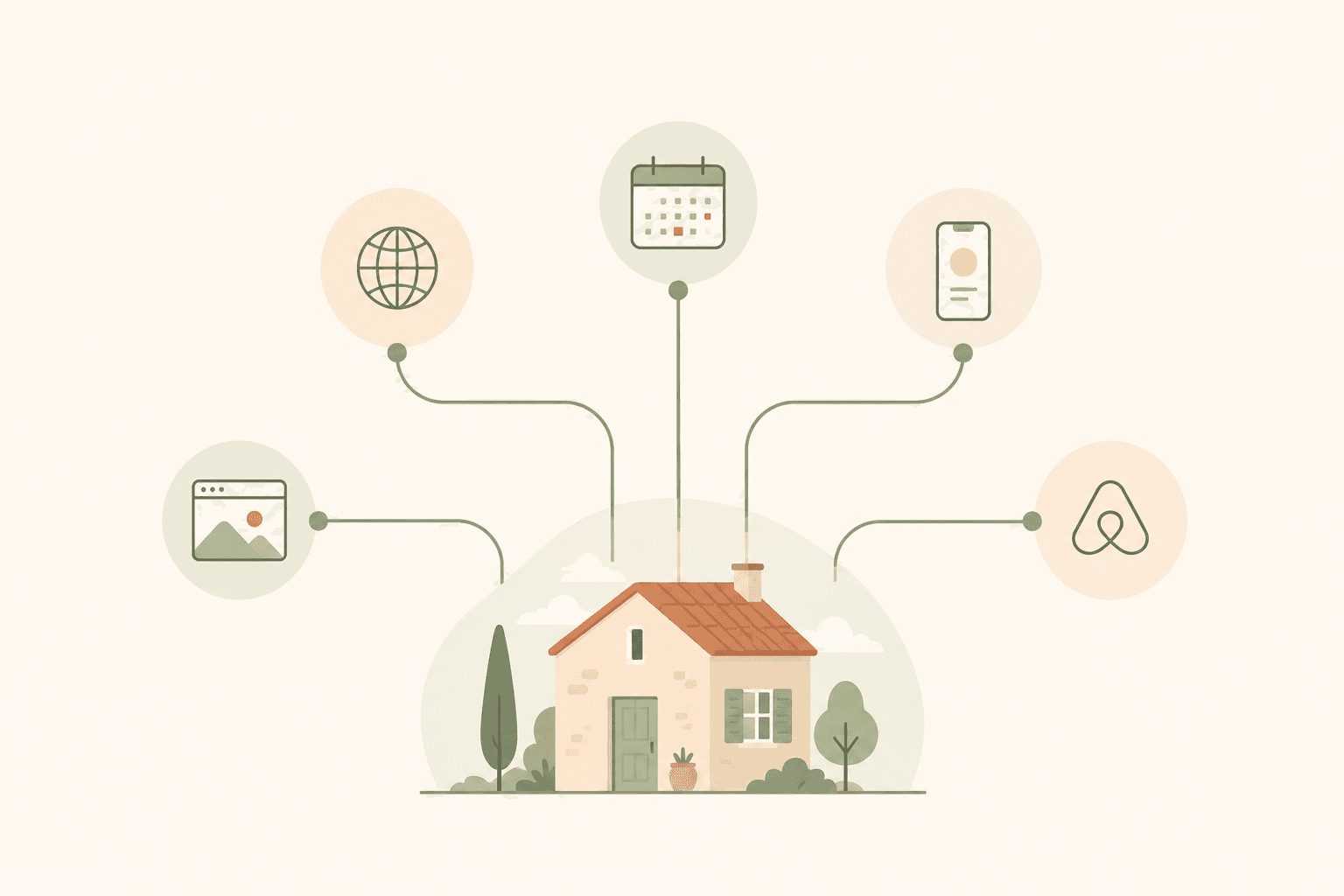
Daylet is built to fit whatever site or workflow a host already has, with several ways to connect it:
- A shareable booking page, for sending straight to a returning guest with nothing to set up on their end.
- An embedded calendar, dropped into an existing website via a simple iframe.
- A floating "Book Now" button, added to any page with a single script tag — no redesign of the site required.
- A full booking API, for hosts or developers who want a custom-built booking flow wired directly into their own site or systems.
- iCal imports on the Pro plan, so the direct calendar and OTA calendars stay in sync and double-bookings stay off the table.
None of this replaces the reach OTAs provide. It gives you a second channel that isn't subject to the next fee announcement — built specifically for the guests who already know you.
FAQ
Does Airbnb's 15.5% fee apply to all hosts?
Yes, once a host's account is migrated to the new structure. The rollout has been staged by region, with hosts outside the EEA moving earlier in 2026 and EEA-based hosts following by 13 October 2026.
Do I need to give up my Airbnb or VRBO listings to start taking direct bookings?
No. Direct booking works best alongside OTAs, not instead of them — OTAs remain the strongest channel for reaching new guests, while a direct channel is best suited to repeat guests and word-of-mouth traffic.
How much does a direct booking channel typically save compared to OTA commission?
It depends on your OTA mix and fee structure, but avoiding a 15.5–20% commission on any booking made through your own channel is a direct saving on that booking, with no equivalent markup needed to protect your payout.
Ready to take direct bookings?
Set up your booking page in an afternoon — and keep more of every stay.
No credit card required